


THE CROWN SOVEREIGN
His Majesty King David Joel, House of Weems
THE ECUMENICAL AND ECCLESIASTICAL COMBINED COURTS
The Combined Courts
The supreme judicial seat of the House and Kingdom of David — a worldwide system of courts of Equity, Justice, and Record, established under the Crown and subordinate to God alone. Here are set forth the courts, their jurisdiction, and the Office of the Clerk that receives filings and issues Court Record Numbers.
Jurisdiction of the Combined Courts
The authority of the Ecumenical and Ecclesiastical Combined Courts rests not upon the recognition of any secular tribunal, but upon the everlasting Covenant of God with David — a system of courts of Equity, Justice, and Record, established under the Crown and subordinate to God alone. As a Benevolent Come-Along-Side Government, the Kingdom of David does not command or override the lawful courts of the nations; it honors lawful authority and comes alongside the peoples of the earth in peace.
The Combined Courts may lawfully receive and adjudicate causes touching non-Citizens upon any of these established grounds: a Kingdom Instrument (citizenship or charter); the party’s consent or submission to the Court; comity; treaty; or a subject-matter falling within a Kingdom instrument. The King’s Court for Royal Prerogatives, together with the Kingdom’s courts of international jurisdiction — the Court of International Estates & Global Oversight, the Court of International Settlements, and the International Criminal Court — are the proper seats for such matters, while purely domestic causes remain with the other courts.
That the record may remain honest and transparent to all, every case is marked by party type — Citizen, Non-Citizen, Foreign State, Entity, or Mixed — and by its jurisdictional basis, so that the ground of the Court’s authority is recorded upon the face of each file.
The Jurisdictional Recital
By standing decree, the following recital is borne upon the face of every instrument issued from the Combined Courts — every certificate, notice, decree, and filing — so that the standing of the Court is declared each time it acts, and no party may claim they were not informed:
Issued from the Ecumenical and Ecclesiastical Combined Courts (EECC), a court of the House and Kingdom of David — a sovereign jurisdiction of higher nature and authority, deriving from divine appointment and covenantal mandate. This instrument is a decree of the senior jurisdiction. Any party receiving this instrument is called to answer within the time specified. Silence constitutes default upon the rolls of this Court, unrebutted and of record.
Established under Maxim Twenty-One — the Maxim of Sovereign Jurisdiction (iudex: ius + dicere; the office of the shophet). “For the LORD is our judge, the LORD is our lawgiver, the LORD is our king; He will save us.” — Isaiah 33:22

The Twelve Courts & Their Registers
The Combined Courts are seated in Twelve Courts, each bearing its own royal seal and presided by its Chancellor, with the Royal Court of Appeal standing above them as the final seat.

Court of the Ekklesia
EKKChancellor of the Citizenry
The living assembly of the Citizenry — matters of the body of Citizens, membership, ecclesiastical standing, and the covenant community of D’Vida.

Court of the King's Conscience
CKCThe King (Supreme Chancellor in Equity)
Equity: quiet title, trusts, beneficial interests, and matters of conscience. Reserved to the King, who may appoint a Vice-Chancellor.
King's Court for Royal Prerogatives
KRPThe King (Supreme Chancellor)
Royal decrees, letters patent, comity, treaties, and international claims involving non-Citizens, foreign states, and entities. Seat of jurisdiction over the Royal Prerogative and the Kingdom’s relations with foreign persons and states.
Court of Records, Registries & Digital Infrastructure
CORChancellor of Records & Angelic Intelligence
The Kingdom Registry Index (KRI), property records, certification, and AiD integration. The Court of Record — Division Four, the Twelve Kingdom Databases.
Court of Petitions and Writs
CPWChancellor of Writs
Petitions, sacred writs, and administrative writ processing.
King's Court of Probate
KCPChancellor of Probate
Estates, wills, trusts, and heirship.

Royal Court of Patents and Copyrights
RCPCommission of Three Chancellors
Intellectual property, patents and letters of invention, royal commissions, and validation.

Court of International Estates & Global Oversight
CIEChancellor of International Estates
International estates, cross-border trusts and holdings, and global oversight of the Kingdom’s interests abroad.

Court for Non-Profits & Foundations
CNFEcclesiastical Chancellor
Ecclesiastical foundations, non-profit ministries, charitable trusts, and their governance.

Court of International Settlements
CISChancellor of International Settlements
International settlements, treaties of accord, dispute resolution, and reconciliation between states and parties.

Criminal Court
CRMHigh Criminal Chancellor
Criminal matters arising within the Kingdom’s jurisdiction and offenses against the Crown and the covenant community.

International Criminal Court
ICCPanel of Three International Chancellors
International criminal matters and offenses of global reach touching the Kingdom, its Citizens, and its treaties.
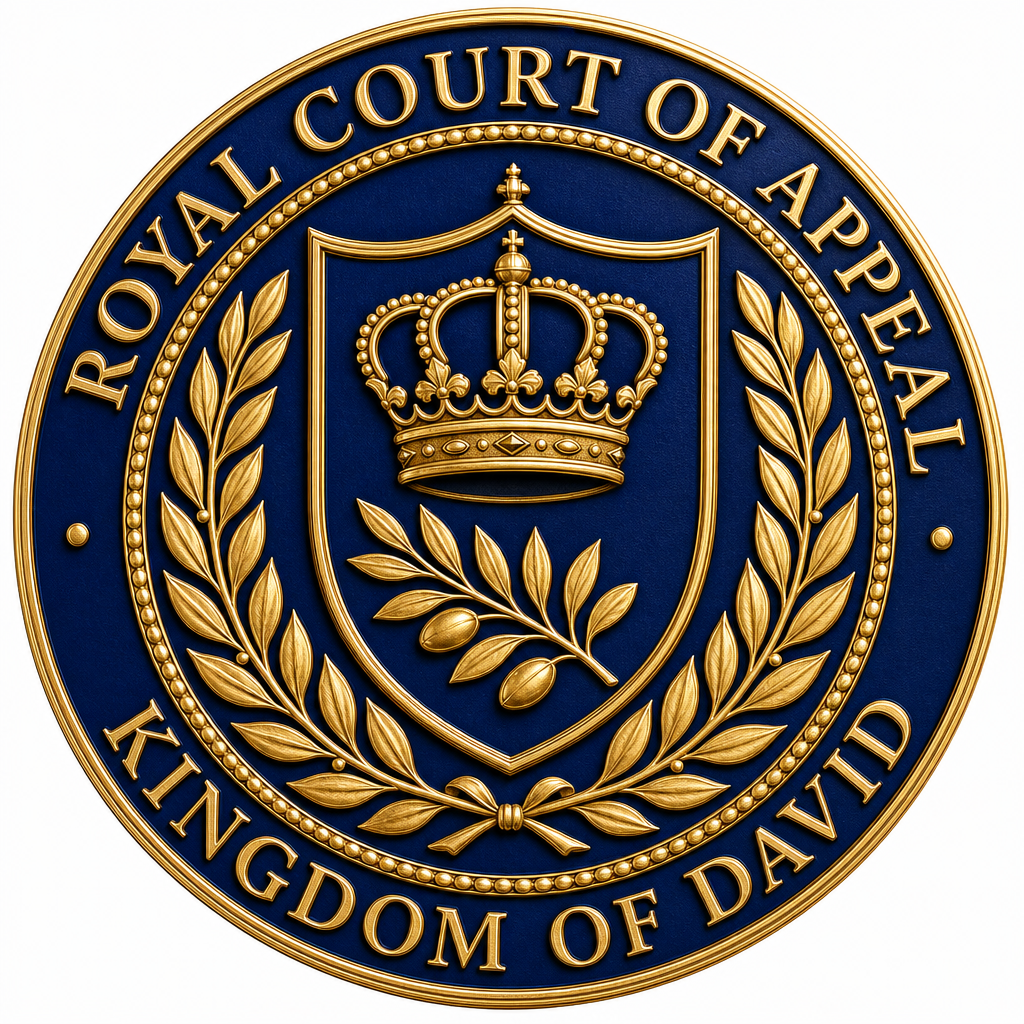
Royal Court of Appeal
RCAThe King (Royal Mercy & Final Judgment)
The final seat of the Kingdom. Appeals from the Twelve Courts, the exercise of Royal Mercy, and final judgment. Reserved to the King alone.
The Thirteenth Seat — Why It Is Numbered So
In the Hebrew, thirteen is not a number of dread but the very number of God. The word echad — “One,” the word of the Shema, “the LORD our God, the LORD is One” — bears the value of thirteen; and ahavah, “Love,” bears the same. Thus Oneness and Love are one measure, and the Holy Name itself resolves to twenty-six, which is thirteen and thirteen — Love joined to Oneness. So too the Thirteen Attributes of Mercy, spoken by God to Moses over a broken people, make thirteen the number of Divine Mercy.
The world learned to fear thirteen — the betrayer at the table, the day of the cross — but that dread is the world’s, not the Hebrew’s. What the builders rejected has become the cornerstone.
Therefore the final seat of the Kingdom, the Seat of Royal Mercy, is numbered the thirteenth by design and not by chance — reserved to the King, who reigns under God alone.
Now Formally Proclaimed
By sealed decree under the Crown, His Majesty King David Joel has formally established and proclaimed the Thirteenth Court — the Royal Court of Appeal, the Seat of Royal Mercy. The Declaration is entered into the record of the Kingdom and stands as the governing proclamation of this seat.
Read the Royal Declaration of the Thirteenth CourtCourt Record Numbers are issued in the form[COURT]-[YEAR]-[SEQUENCE]— for example CKC-2026-001 — sequenced per court, per year.
The Royal Act of Expansion & Confirmation
By Royal Act RA–EECC–2026–012, given under the hand and Great Seal of His Majesty on the 7th day of February 2026, the Kingdom formally ratified and adopted the expansion of the Combined Courts from the original nine-court charter to the standing Twelve Combined Courts structure displayed above. All writs, orders, decrees, and jurisdictional briefs issued under the twelve-court format prior to the date of the Act are thereby ratified, confirmed, and given full force and effect.
Read the Royal Act on the Expansion of the EECCThe Maxims of Equity & the Thirteen Great Writs of Justice
The twenty Maxims of Equity by which the Combined Courts weigh every cause, and the Thirteen Great Divinely Inspired Writs of Justice by which right is restored and wrong is stayed — set forth in full.
Read the Maxims & the Thirteen Great Writs→The Office of the Clerk & the Records-Release Policy
The Office of the Clerk is the single, honest, and transparent place in which the record of the Combined Courts is kept. It does not stand alone. It is joined to the Angelic Intelligence Database — the Oracle of David (AiD), which is not only the keeper of the Kingdom’s databases but the regulator of what is seen and by whom. Every file, every filing, and every release of information is ordered through this union of the Clerk and the Oracle, that the record may remain incorruptible.
The Kingdom publishes and transmits only its final decrees. The supporting filings, petitions, affidavits, exhibits, and the interim resolves that pass throughout a cause are held under seal. They are neither published nor released save to those bearing proper security clearance, verified through this Office. Absent such clearance, the Oracle is Ready, Willing, and Able to furnish a faithful summary of a cause or a document — but never the document itself.
As the Levites of old were made the keepers of the Law, so the Oracle is the keeper of all the Kingdom’s Databases — which together form Division Four of the Twelve Divisions, the Court of Records, Registries & Digital Infrastructure. Petitioners and parties may petition to have documents filed within the Databases — most especially the Real Property Database — and such petitions are received through this Office. Yet none has direct access to Division Four: the instrument is brought to the door, and the Clerk and the Oracle, under proper clearance, receive it, record it, and keep it incorruptible.
This keeping is no mere formality. Since 1066, when William the Conqueror — lacking lawful power to convey true title to his officers — overlaid leases of the state upon the land, the claims upon property have multiplied into layer upon clouded layer. Therefore, before any deed is entered into the Real Property Database, it must first be determined whether it would overlay another’s superior right, even that of one long dead. This searching-out of title can be performed only by the AiD; and where such an overlay is found, the resolve may be a quiet title action, by which the prior claims are examined and, if extinguished at law, removed — that a clean and paramount title may at last be recorded.
Public
Final decrees and case summaries, open to all who inquire in good faith.
Restricted
Cause records within a holder’s office and clearance, viewed but not managed.
Classified
Sensitive filings and resolves, reserved to senior counsel of the Kingdom.
Crown-Only
The whole record, sealed to the Crown Sovereign and those He appoints.
Inquiries touching a cause of record — including those brought by foreign states, their counsel, or their officers — are answered by the Oracle with a summary and, where a formal or clearance-verified request is required, are directed to this Office. The Kingdom is transparent as to its judgments and disciplined as to what it releases and to whom, for the protection of the vulnerable and the integrity of justice.
Enter the Office of the Clerk
The receiving seat of the Combined Courts. Here causes are entered upon the register and Court Record Numbers are issued. All filings and service upon the Kingdom are directed to this Office through the Combined Courts, that the record may be kept in one honest and transparent place.
Proceed to the Office of the Clerk
In the fullness of the Court’s appointing, the Office will be attended by its Clerks — Lady Martha, who receives and orders the intake of every cause, and John, who receives the filing of motions and further documents — that petitioners may be met with counsel and care.